Study and teaching
Middle Ages section

Section overview

Get a quick overview of the special features of our section: the courses offered, special style sheets and helpful links throughout your studies.

The colloquium takes place on Tuesdays (4:15 – 5:45 pm)

Venue: Raum S3|13, 110

14.10.25 entfällt

21.10.25
Gerrit Jasper Schenk: Einführung / Prüfungsberatung

28.10.25
Yannick Pultar (Mainz): „Die Grafen von Württemberg, Esslingen und Markgröningen. Drei Könige und ein Konflikt“

04.11.25
Michael Schonhardt (Darmstadt): „KI und Sprachmodelle in der mediävistischen Forschung“

11.11.25
Hartmut Kühne (Berlin/Leipzig): „Testfeld vor den großen Ablasskampagnen. Der Nördlinger Kirchbauablass von 1480 und die Städteablässe unter Papst Sixtus IV.“

18.11.25
Letizia Curreri (Darmstadt): „Crisis Management and Multi-level Governance in the Middle Ages: The Case of the Military-Religious Orders in the Mediterranean“

25.11.25
Nicolai Hillmus (Darmstadt): „'Einst wateten die herrschaftlichen Rosse im Schlamme großer Wassermassen…' Transport und Verkehr in der vormodernen Flusslandschaft der Weschnitz“

02.12.25
Patrick Unterstock (Muttersholtz): „Die Schiffahrt auf der Ill“

09.12.25
Linus Pascher (Heidelberg): „Der Umgang mit der Weschnitz in mittelalterlichen und frühneuzeitlichen Weinheim”

16.12.25 Nicolas Gries (Darmstadt): „Das deutsch-deutsche Gedenken zum Bauernkrieg 1975“

13.01.26
Raphael Longoni (Darmstadt): „‚Keeping the flow‘ – Institutional resilience in the floodplains of selected Upper Rhine tributaries, c. 1400-1700“

20.01.26
Stephan Ebert (Darmstadt): „Food Studies in der Vormoderne. Das Beispiel Basel im späten Mittelalter“

27.01.26
Raphael Thun (Darmstadt): „Reisen zwischen Erlebnis und Imagination – Mobilitätsnarrative in der griechischsprachigen Literatur des 2. Jahrhunderts n. Chr.“

03.02.26
Georg Walter (Darmstadt): „‘Wer meret Schweitz dann der herren geytz?‘. Diskurse der Eidgenossenschaft als idealisiertes Konstrukt und realpolitisches Gegenüber in der Bauernkriegszeit (1493-1526)“

10.02.26
Christian Hoffahrt (Kiel): „…et multum etiam sunt deformes. Menschliche Körper und die Konstruktion des Fremden im Spätmittelalter.“

To register for this exam please fill in the special form at the Institute of History (opens in new tab) AND register in TUCaN. For more information, contact Prof. Schenk or Prof. Weileder via email.

You may choose from a wide range of literature: literature Prof. Schenk (opens in new tab)/ literature Prof. Weileder. (opens in new tab)

Please contact Prof. Schenk or Prof. Weileder to fine-tune your supervised reading-exam.

Open Moodle courses

The Open Moodle courses allow you to prepare, follow up and revise core content of the history programme, particularly medieval history, anytime and anywhere.

Please switch to the German version for more information

Latin courses at TU Darmstadt

In cooperation with the RMUniversities, we now offer a larger variety of Latin courses. Find out more on our website.
Mehr erfahren

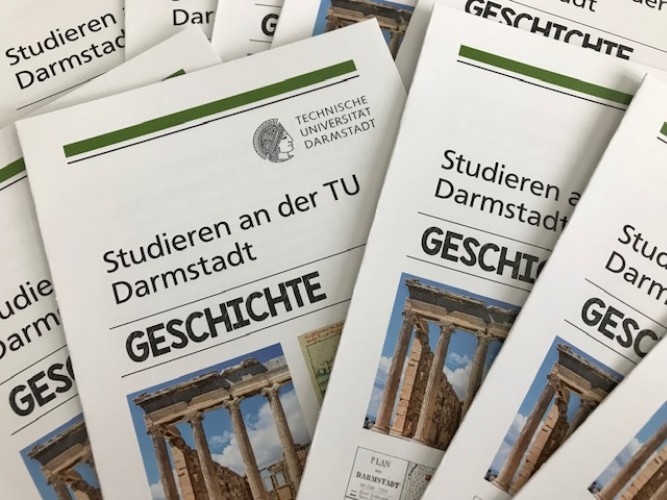
Picture: Anita Schilz

Did you know?

The main sites of the Institute of History provide information about studying history: introductory notes on the study programme and its structure, summaries of the individual module manuals, details on studying abroad and on job prospects after graduation.

Further information